By:Melody Bergquist and Kim Kidder
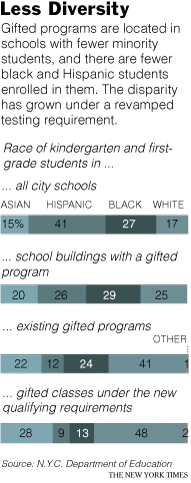
Excellence gap is a term of the 21st century that identifies achievement gaps among the highest achieving students. The gap appears early on in the elementary school years and widens as the student progresses through high school. The excellence gap under identifies talented and gifted students that are considered educationally disadvantaged.
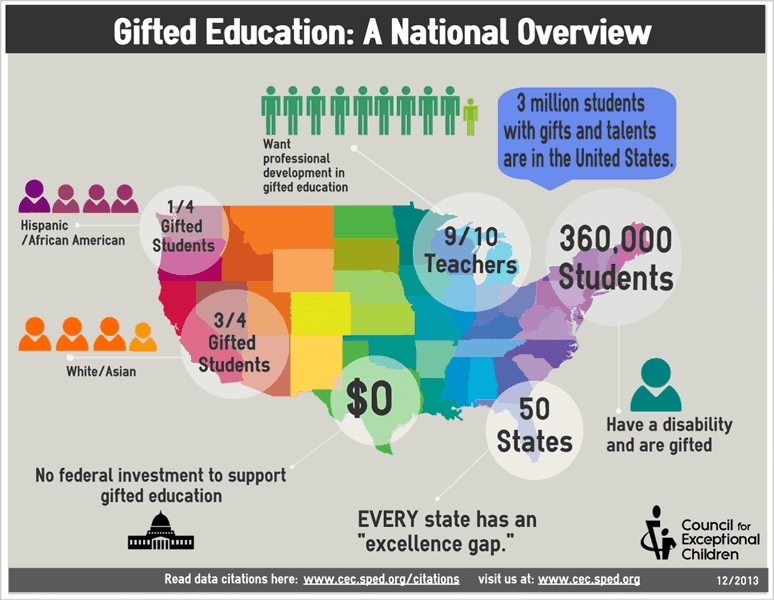 |
| Source: Gifted Education: National Overview cec.org |
The educationally disadvantaged are students who are considered a minority group at the school, district, state and sometimes the national level. Like the underachieving student, students that fit into the excellence gap, represent a minority. The discrepancy is usually a socioeconomic factor that is directly correlated to wealth. Contextual factors such as poverty, negative peer pressure, and discrimination are some of the most easily identifiable influences on achievement gaps.
Lohman, the author of An Aptitude Perspective on Talent: Implications for Identification of Academically Gifted Minority Students, points to the fact that the language spoken by the child effects placement into gifted programs (2015). Many gifted and talented programs rely on aptitude to determine placement. Aptitude is directly linked to context. This automatically puts the English Language Learner at a disadvantage. Lohman believes more minority students will develop excellence if they were provided the opportunity to develop the skills.
The bar graph below supports Lohman's position. It compares English Language Learners with all other students in the state of Massachusetts. ELL students were significantly less likely to graduate high school within five years in comparison to the rest of the student population in the state.
It is important to identity these learners, also labeled as high potential learners, and uncover what is holding these learners back from meeting their potential.

Technology, with it's many benefits, also has a hand in widening the excellence gap. Hardesty, McWilliams and Plucker recognize the importance of technology rich environments that include 1:1 initiatives that incorporate laptops and iPads into daily learning. For students that do not have frequent access to technology, they are at a disadvantage. Technology usage is a form of career and college readiness training. It prepares learners for future careers that use technology to communicate, work collaboratively and creatively design products and services. A lack of access to the technology and tools leads to a greater disparity of underrepresented students in high ability classroom settings.
Lohman, the author of An Aptitude Perspective on Talent: Implications for Identification of Academically Gifted Minority Students, points to the fact that the language spoken by the child effects placement into gifted programs (2015). Many gifted and talented programs rely on aptitude to determine placement. Aptitude is directly linked to context. This automatically puts the English Language Learner at a disadvantage. Lohman believes more minority students will develop excellence if they were provided the opportunity to develop the skills.
The bar graph below supports Lohman's position. It compares English Language Learners with all other students in the state of Massachusetts. ELL students were significantly less likely to graduate high school within five years in comparison to the rest of the student population in the state.
It is important to identity these learners, also labeled as high potential learners, and uncover what is holding these learners back from meeting their potential.

Technology, with it's many benefits, also has a hand in widening the excellence gap. Hardesty, McWilliams and Plucker recognize the importance of technology rich environments that include 1:1 initiatives that incorporate laptops and iPads into daily learning. For students that do not have frequent access to technology, they are at a disadvantage. Technology usage is a form of career and college readiness training. It prepares learners for future careers that use technology to communicate, work collaboratively and creatively design products and services. A lack of access to the technology and tools leads to a greater disparity of underrepresented students in high ability classroom settings.
What Impacts does the Gap have on the Educationally Disadvantaged?
The reason society as a whole need to care about these excellence gaps is numerous. Students who are not identified, who are unchallenged, or under served will not reach their fullest potential. Latino and black students' enrollment in selective colleges has declined between 1972 and 2004 and many students deemed highly qualified to attend a selective college did not attend one (Lohman 2005). For these students, this means less job opportunities, possibly less meaningful work experience, lower earning potential, and possibly less of an impact they could make on contribution to society.
Challenges as an Educator...
Educators face an uphill battle advocating for high ability programs. The Federal Government mandates that states identify talented and gifted students through the "Every Student Succeeds Act" (ESSA), but provides no funding do so. Each individual state determines the extent of the of talented and gifted education as well as the funding.
Talented and gifted program implementation, state mandates and budgets vastly vary by state. Iowa, for example, requires gifted and talented teachers to be endorsed. There are state guidelines which include every public school district to have a Gifted and Talented Coordinator and a well documented program. Iowa provides over $40 million in funding throughout the state.
Nebraska, on the other hand, only requires districts to identify talented and gifted students and to provide services. Programs are at the discretion of the individual school district, teachers do not need an endorsement and there is little oversight. Nebraska only provides approximately $2 million in support to the entire state. Most, if not all of the cost burden falls onto the district. When faced with a budget crisis, such as my current district, talented and gifted programs are put on the chopping block.
How do Educators Close the Gap?
What is the position of National Association of Gifted Children?
National Association of Gifted Children
The National Association of Gifted Children (NAGC) believes the "excellence gaps is an issue of equality and social justice, community development, economic advancement, and national security". The graph above titled, "Gifted Education: A National Overview", clearly paints a picture of the inequity. White and Asian students represent three quarters of all gifted and talented students in the United States, while black and Hispanic students make up the other quarter of students identified as high ability.
9 out of 10 educators throughout the nation want training in gifted and talented education. Teachers need to advocate for the success of high ability students by requesting staff development. They also need to communicate with the community, board members and state legislature on the importance of funding talented and gifted programs.
.
Source: Jack Kent Cooke Foundation
Personal Reflection...I have learned there are populations of students who under perform relative to their peers and their potential this is an achievement gap. At the highest level of learning this also happens, and the term given to this is an Excellence Gap. I have experienced this first hand as a fourth grade teacher. Working under No Child Left Behind, the primary focus has been to get the lowest performing students to meet proficiency. It is my opinion that the pressure put on schools through Adequate Yearly Progress (AYP) goals has led to this focus. In the past year, there has been a slight shift towards looking at individual student growth rather than meeting a proficiency goal. Hopefully this will lead to looking at all students and how they are progressing and a shift away from such an intense focus on the lowers.
Click on the link below to to hear Jonathan Plucker speak about the Excellence Gap.


No comments:
Post a Comment